The Forest Art Intelligence project is a unique art-science initiative conceived by experimental artist Keith Armstrong. In collaboration with a team of scientists and science educators from QUT and TERN, Keith has established a site-based interactive installation located at the Samford Ecological Research Facility north of Brisbane. The project frames a regenerating forest as an evolving, living artwork that encourages visitors observe the regenerating forest through an artistic lens and, in so doing, deepen their engagement with the intelligence of natural systems.
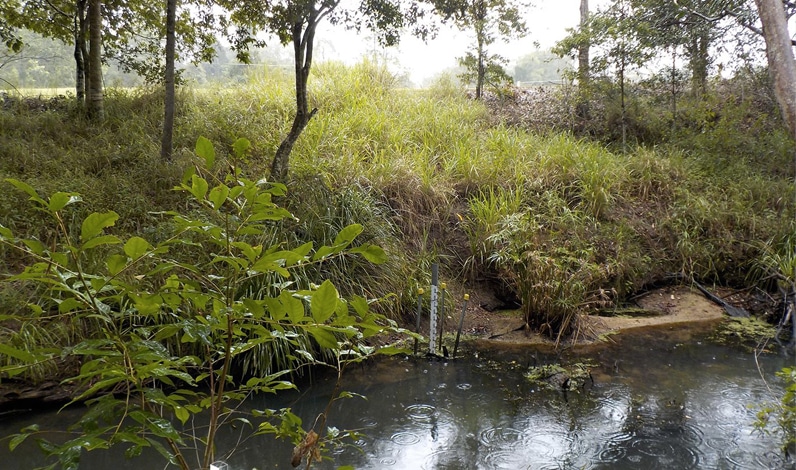
On a warm day under clear skies in early November the Samford Ecological Research Facility (SERF) north of Brisbane, and home of TERN’s peri-urban SuperSite, opened its doors to the community. Members of the public were invited to explore the Engaging Science Trail, an interactive experience for research infrastructure education jointly hosted by SERF and TERN. The trail meanders through 51 acres of eucalypt and notophyll vine forest, open grasslands and remnant rainforest, and offers an opportunity to see the TERN eddy covariance flux tower, and learn about soil carbon research in a pasture of native and exotic grasses, and to visit domed screen houses to learn about studies on native bees and mealy bugs. The scale of the SERF site enables visitors to spread out and enjoy the hushed sounds along the trail: one’s own footsteps on the dry leaves, the springtime chitter of honeyeaters and silvereyes or the gentle, descending whoops of a pheasant coucal hiding in the dense understory. Here and there the trail crosses dry creek beds fringed with native sedges, mat-rushes and other riparian life quietly waiting for the rain to return. There are blue gums, ironbarks, red gums and pink bloodwoods, too. Vines of Parsonia straminea twist through canopy, their long seedpods split and tiny seeds’ silky white tufts drift silently through the forest almost like snow. It’s like walking through a living work of art, one in a constant process of being made and remade.
“SERF is very special, indeed,” says experimental artist Keith Armstrong.
For more than thirty years, Keith has specialised in collaborative, interdisciplinary arts projects, and has a particular interest in art-science collaborations relating to ecology and the environment. He believes SERF is an ideal place to bring art and science together to counter the growing problem of environmental disconnection.
TERN Samford Peri-urban SuperSite
“Despite humanity’s unprecedented technological advances, many people remain fundamentally estranged from the ecological systems that sustain all life,” he explains. “Our increasing emotional disconnection from that world limits our understanding of the complex, distributed agencies at play in these systems, and decreases our motivation to protect them.”
“Experimental art methodologies – particularly those rooted in process art – have the potential to meaningfully deepen public engagement with the intelligence of natural systems,” he explains. “This can offer new avenues for public environmental education.”
In 2023, Keith embarked on a new art-science project, Forest Art Intelligence (FAI), which frames a regenerating forest as an evolving, living artwork. The interactive, site-based interactive installation is located at SERF and was conceived as a long-term, deep collaboration between artists, ecological scientists, land managers and educators, informed by Traditional Owners.
“Forests are intelligent entities that evolve through numerous stages over their lifetimes, mediated by cycles of life, death, regeneration and human influence. By framing that evolution as “process art,” the project parallels how contemporary process art values each stage of an artwork’s creation and transformation as much as any intended future outcome.”
Credit: Keith Armstrong
The project began with a 2-hectare block of former pastureland located at SERF, which had been reserved for regeneration back to native forest. It was an ideal setting to observe intricate natural networks carrying out the process of repair and regrowth.
“FAI offers a powerful proposition to audiences: that natural environments can and should be understood as principal creators within their own artistic and ecological frameworks,” says Keith.
From the outset, it was crucial that the protection and regeneration of the site should be scientifically guided and monitored, so he has been working closely with the FAI Collaborating Science Team, which includes Dr David Tucker, (QUT Landscape Ecologist), Dr Gabrielle Lebbink (QUT Freelance Plant and Invasion Ecologist), Dr Eleanor Velasquez (TERN Education and Training Manager) and Marcus Yates (QUT/SERF Site Technician), with additional support from A/Prof Caroline Hauxwell (QUT Microbiologist and Agricultural Biotechnologist).
“The Forest Art Intelligence project provides this really unique opportunity to bring together two very different disciplines: of art on one hand and science on the other,” explains Dr Eleanor Velasquez, who was instrumental in establishing the SERF Engaging Science Trail. “FAI uses the lenses of these different disciplines to translate the innate intelligence of an ecosystem and the regrowth of that ecosystem into a different form.”
The Collaborating Science Team Clockwise from top left: Dr David Tucker (QUT), Dr Gabrielle Lebbink (QUT), Marcus Yates (QUT/SERF), Dr Eleanor Velasquez (TERN). (Credit: Keith Armstrong and the science team)
With the guidance of the Collaborating Science Team, the 2-hectare site was cleared, and a one-hectare stretch was burned to aid its recovery from weed infestation. The site was divided into recovery zones based on botanical observations and then mapped using LiDAR aerial and ground-based technologies.
Next, Keith and his colleagues planned and introduced a small number of on-site installations, each designed to benefit the regenerating forest. “We are developing embedded artworks, comprised of ecological materials, capable of slowly finding, and then occupying, their own intelligent ‘niches’, within the forest’s ecology – a speculative form we call an ‘Art Intelligence’,” Keith explains.
Top image: aerial view of the FAI site at SERF (Credit: David Tucker); Bottom left: Area burned to promote regeneration (Credit: QUT REF group); Bottom Right: David Tucker (left) and Gabrielle Lebbink (right) surveying the FAI site (Credit: Keith Armstrong)
Blue Gum limb transported to the FAI site (Credit: Keith Armstrong)
A key feature of these Art Intelligences involved a fallen, two-tonne limb from a Queensland Blue Gum, which was relocated to the site in 2024 with the help of a mobile crane. As it decomposes it will serve as a host for new life, explains Keith. “It will offer increasingly valuable shelter, nourishment and suitable microclimates for multiple on-site animal and plant species.”
This and other Art Intelligences of the FAI site have been incorporated into the SERF Engaging Science Trail since 2024. Indeed, the FAI site is now a key feature of the trail, inviting visitors to pause and observe the regenerating forest through an artistic lens.
Top image: cavities were carved into the log which were capable of retaining water and organic matter within the log body; Bottom image: underside view of the Blue Gum log. By late 2025 a variety of fungi, mosses and a myriad of insects had begun to explore the log, and it was also attracting local birds and mammals (Credit for both images: Keith Armstrong)
Scientific Monitoring: turning data into media art
The entire FAI site, including the Blue Gum limb, has been periodically monitored both aerially and terrestrially with the aid of LiDAR scanners, acoustic observatories, camera traps and video monitoring. Keith was also provided access to historic data and LiDAR scans. Through his collaboration with Eleanor (TERN) he was also given access to TERN’s database.
In addition to their intrinsic scientific value, the observations and data collected during the FAI project are also regarded as digital art materials, which Keith has begun to incorporate into major off site media art installations: the first two of which are Analog Intelligence(2024) and Translucent Kinship (2025). The results are stunning and thought-provoking with each installation offering yet another way to view the intelligence of a natural system in the process of regeneration.
Laser scan of 'Art Intelligence' (Credit Keith Armstrong)
Analog Intelligence
Analog Intelligence, is a video installation that explores the project’s first stages, namely the R&D stage developed during the first six months of the project. It incorporates observational data collected during that time, including laser scans as well as acoustic and camera trap observations. Analog Intelligence was presented at the International Symposium of Electronic Art, which was held at QUT in June 2024.
A series of stills from the Analog Intelligence installation (Credit: Keith Armstrong)
Translucent Kinship
Translucent Kinship is an immersive 6-screen installation room projection using laser derived data of the forest in recovery. It premiered for ANAT SPECTRA 2025: Reciprocity, at the University of the Sunshine Coast in October 2025.
Translucent Kinship 5 minute loop (Artwork credit: Keith Armstrong, video credit: Keith Armstrong, Toby Gifford)
A New Paper
Developing a unique approach to environmental education has been an important aim throughout the FAI project, explains Eleanor.
“Coming from the science and art perspective, the FAI project has allowed me to think deeply about the different discipline lenses through which we relate to the world and how that changes our perspective and thinking about an ecosystem,” she says. “From the scientific point of view, when I’m teaching it’s often framed as teaching about a forest or ecosystem and extracting data from that place or system in order to understand it better, which is very important, of course and provides us with the data to understand and unpack the complexity of environmental change.”
“The FAI project, however, allows a slowing down of that thinking, providing a platform for a relational way of teaching and thinking ‘with’ the forest, rather than ‘about’ the forest,” Eleanor explains. “In this way the forest becomes a collaborator and ultimately part of the teaching team, rather than something external. I believe this cultivates more connection and empathy for audiences with a place or ecosystem.”
In their new paper, Keith, Eleanor and their collaborators at SERF, assisted by humanities academics Tania Leimbach (UNSW) and Jane Palmer (USQ), and art critic Carol Schwarzman, introduce a novel approach to environmental teaching practice that is emerging as the FAI project develops.
Right: Dr Eleanor Velasquez discusses FAI at the SERF Open Day 2025 (Credit: F. McMillan-Webster);
Left: Keith Armstrong at the Engaging Science Trail Launch and SERF Showcase Event in 2024 (Credit: Eleanor Velasquez)
Future Forest
FAI is a long-term project, so the site will continue to be monitored over a ten-year period to observe how the ecosystem regenerates.
“The project outcome will ultimately be a fully functioning forest – that will evolve over decades, whether we are involved or not. The forest is being allowed to come back to life in its own time, and in its own way,” says Keith. “Our hope is that it will be allowed to evolve in perpetuity, long after any of the ‘art intelligences’ we have installed have re-integrated themselves back into that sacred place.”