


Since its launch in 2022, TERN’s EcoAcoustics database has become the world’s largest centralised library of bat calls. We speak to ecologist Simon Robson to find out how this is enabling remarkable progress in microbat research, what challenges lie ahead and why there’s no such thing as too much bat call data.
A few years ago, terrestrial ecologist Greg Ford was monitoring bats along North Queensland’s Cassowary Coast when he noticed something unusual. He had recently set up specially designed acoustic monitors that could detect ultrasound chatter in the forest. Bat calls are species-specific, and Greg was familiar with unique sonogram patterns produced by local bat species. Yet as he pored over the latest data, he saw a pattern he’d never seen before. Intrigued, he wondered if it could be a new species. He presented his results at a meeting of the Australasian Bat Society. That’s how Simon Robson caught wind of it.
Simon is a biologist with decades of experience studying bats and is currently an adjunct Professor at Central Queensland University (CQU). Around the same time Greg was collecting recordings on the Cassowary Coast, Simon was collaborating with TERN to establish Australia’s first bat call database: the TERN EcoAcoustics database. Using the details of Greg’s mystery recording, Simon was able to quickly search through hundreds of thousands of calls for a match. There was only one: an identical bat call had been recorded five years earlier in Tully, Qld, which was in the same area. The species was listed as ‘unknown’. That call had been collected almost 10 years earlier and was sitting undiscovered in the new central database. No one had realised its significance. Greg’s suggestion of an entirely new species of microbat had been independently confirmed.
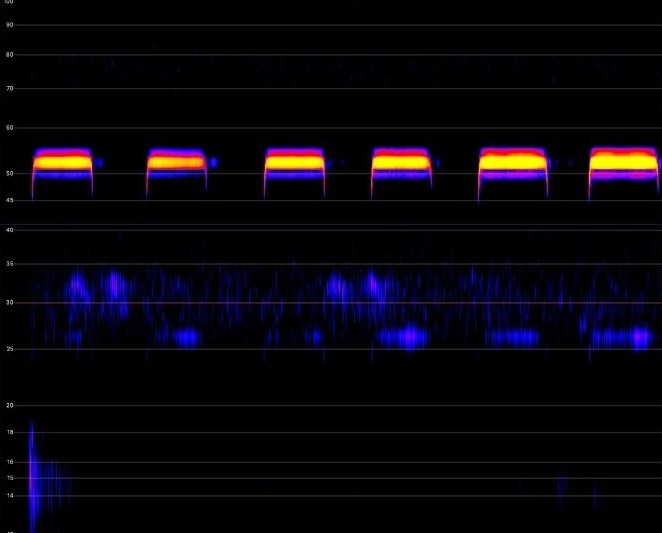
Image left: sonogram of the R51 bat call, it produces constant frequency calls with a mean Fc of 51.85 kHz. There is often an ascending initial and sometimes a descending tail of around 4kHz. Pulse duration averages 48.9 ms.
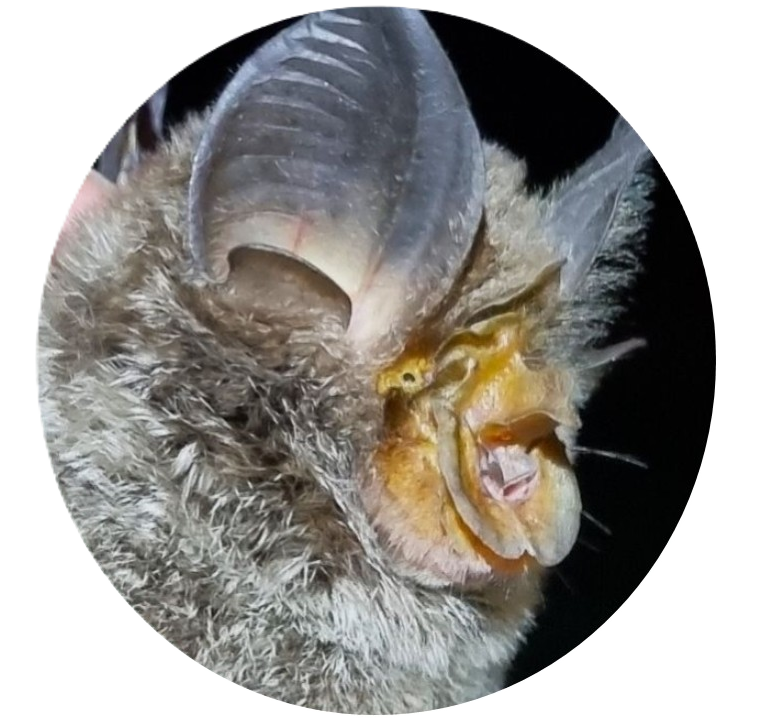
Image below: a closeup of the elusive R51 microbat
(images provided by Greg Ford and Simon Robson)
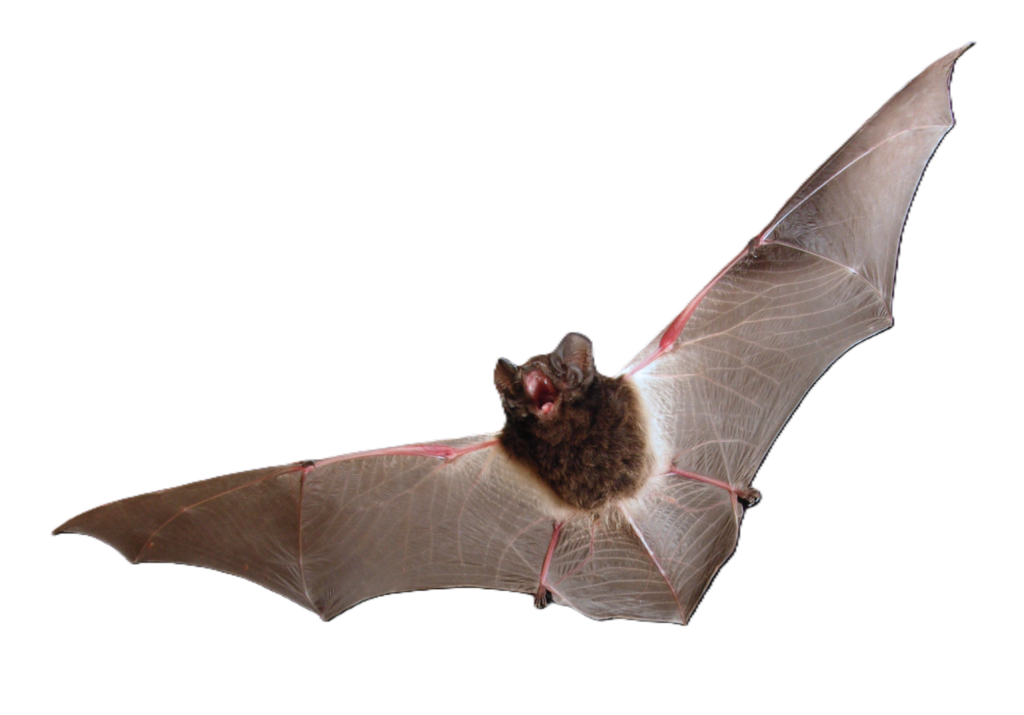
Scotorepens greyi (credit: Michael Pennay Flickr CC BY-NC-ND 2.0)
After discussions with Greg about his findings, Simon, Jon Luly (James Cook University) and their colleagues have spent the last few years conducting intensive surveys to describe the habitat, range and behaviours of this elusive little bat, which has been informally named “Rhinolophus R51” after the frequency characteristics of its calls. Using ultrasound acoustic detectors developed by the Australian company Titley, they determined that it has a small geographic range – just 200 km2. Within that area, it frequents local riparian rainforests as well as altered environments, such as banana plantations and open cattle fields. Then, quite recently, the R51’s distinctive calls were detected on Dunk Island, just a few kilometres off the coast near Mission Beach.
“That’s hot off the press!” says Simon. “It means the bat’s range is a little bit further than we thought.”
“It’s a beautiful example of using these acoustic survey methods to work out not only the existence of a new species, but to begin to map out where it actually occurs.”
He is confident that many more discoveries are possible, especially as the TERN EcoAcoustics database continues to grow.
A completely different world
Given the critical role bats play in ecosystem health and the threats they face from habitat loss and climate change, understanding them has never been more important. But there’s still a lot we don’t know.
Of the two main groups of bats – megabats and microbats – megabats get most of the attention, says Simon. Flying foxes, which are large and easy to spot, are megabats. We’re getting better at understanding them and their role in the ecosystems they inhabit, he explains, but they represent only 15% of Australia’s native bat species. The rest – around 75 species – are microbats.
As their name suggests, microbats are tiny, ranging from as little as 2 grams up to 100 grams. Nevertheless, they are voracious predators and can eat half their body weight in insects each night. While flying foxes use sight and smell to both hunt and navigate, microbats primarily use echolocation – they emit high-frequency clicks and chirps, then use the echoes to detect objects.
“Bats that echolocate live in a completely different world to us,” says Simon. “It’s the echoes coming back from the world rather than the light bouncing off the world that their brain uses to construct images. How they manage to achieve that is quite incredible.”
Moreover, they show remarkable diversity in morphology, behaviours and social systems, but there are a lot of gaps in our knowledge of microbats.
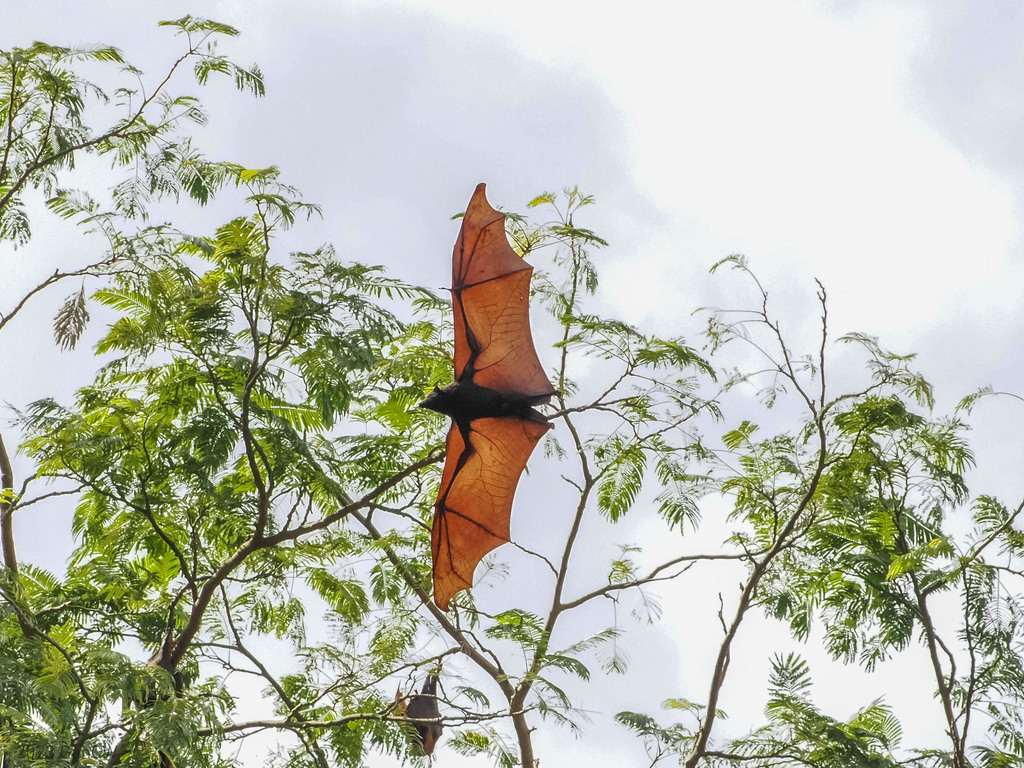
Top right: Golden capped fruit bat (Acerodon jubatus) (image credit: Cheongweei Gan via iNaturalist cc-by-4.0)
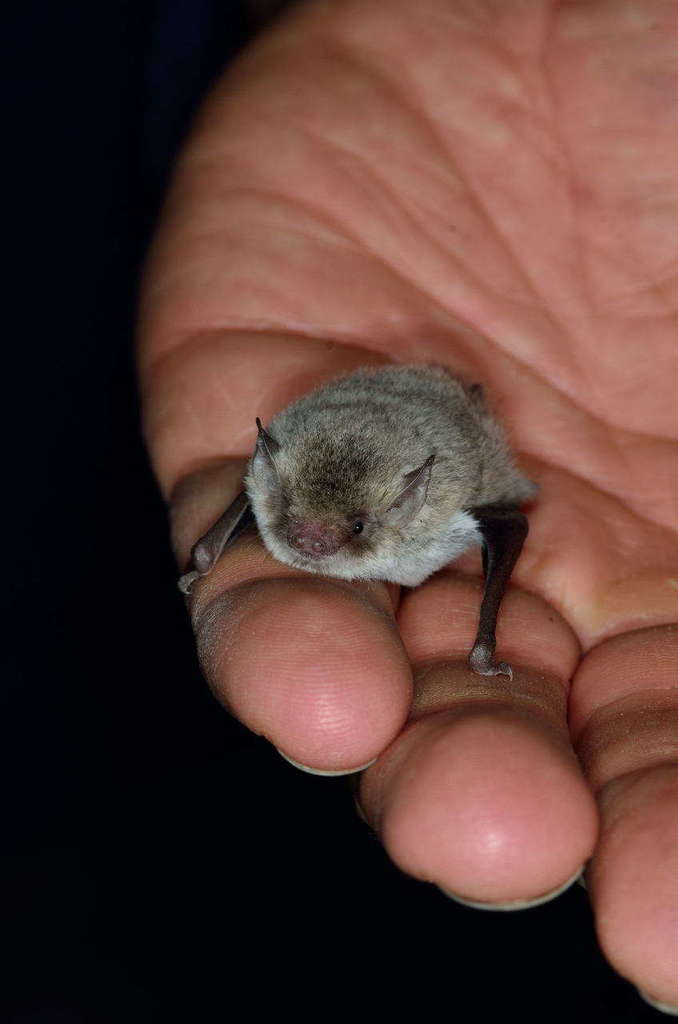
Bottom right: Little forest bat Vespadelus vulturnus (image credit: Chris Lindorff via iNaturalist cc-by-4.0)
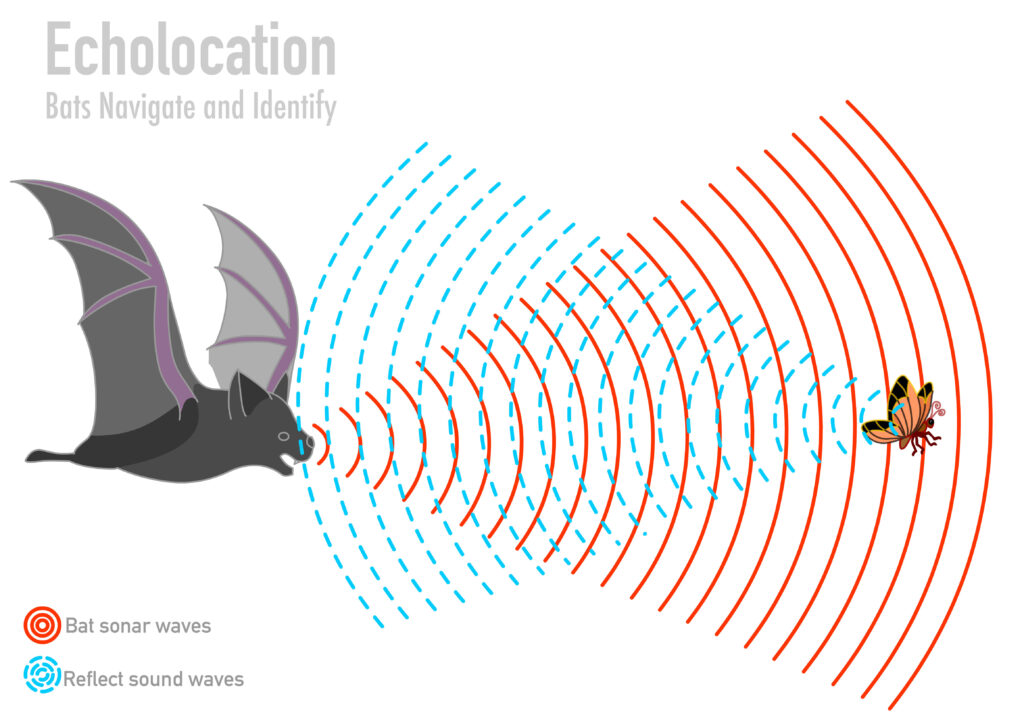
Microbats use echolocation to navigate and detect objects (image credit: Adobe)
“These bats are relatively poorly understood because of the difficulties in observing them,” he says. Indeed, they’re small, quick, easily disturbed and difficult to see in the dark, which is when they’re most active. They also echolocate using ultrasonic frequencies up to 10 times higher in pitch than anything human ears can detect. Fortunately, recent advances in ultrasonic detector technology have made it easier to record microbat calls and are providing a great deal of insight into their world.
A new kind of library
In 2022, TERN funded a project where Simon and his colleague Will Edwards at JCU confirmed the capacity to use Titley ultrasonic recorders to monitor microbats in Queensland. Based on the success of this project, they further collaborated with TERN to develop a central data repository for bat calls. The result was the TERN EcoAcoustics Database.
“People wanted this database for decades, and numerous efforts had been made, but to manage and grow it over time but we needed an organisation like TERN to make it and maintain it at scale,” he says.
“TERN has done a fantastic job of ensuring these data will be available for everyone – they’re completely open access.”
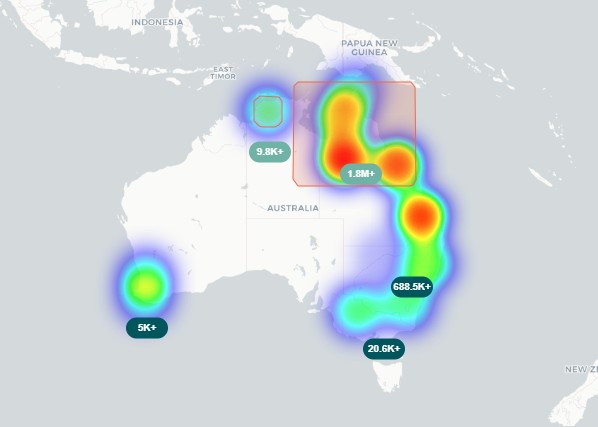
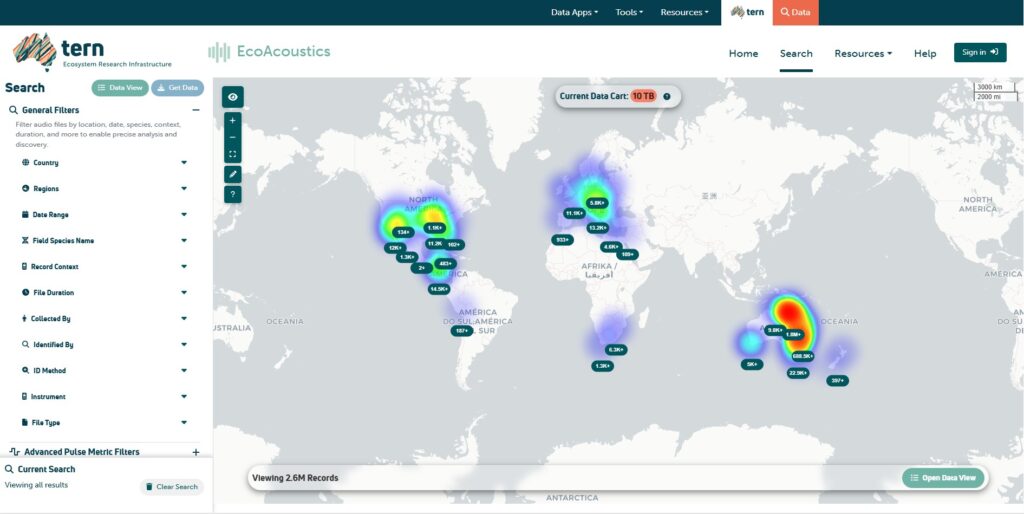
Anyone can download bat calls, and just as importantly, anyone can upload bat call data, as well. Since its launch, there has been a steady increase in the number of recorded microbat calls being added to the database. To date, more than 2.6 million recordings have been uploaded. Most are from Australia, but the recent addition of thousands of bat call recordings from an additional 44 countries have transformed it into a global database.
Finding the right keys
For entries where the microbat species are known, the database is making it easier for researchers to monitor species behaviour, describe habitats, and gauge population and range. It’s also shedding light on call variability within individual species.
Each microbat species has a potentially unique repertoire of echolocation calls, which are shaped by context, including distinct calls to search for, approach and capture prey. When recorded by an ultrasound detector, each call type produces a distinctive shape on a sonogram. Cataloguing every call type for a species is vital, says Simon, because it allows researchers to characterise species more comprehensively. It also improves the accurate identification of microbats in the field and makes it easier to monitor specific behaviours. In addition, it helps researchers determine how many species are represented in a recording. For example, if you record three different calls at a location, you want to know if they are three distinct calls from the same species or if they’re from three different species.
“We’re still spending a huge amount of time trying to know what we’re looking at. Once we crack that, then it will be fantastic.”
But for now, he says, “we’re still often stuck on ‘have we got the right species?’”
He likens it to using a field book to identify birds, but the field book is incomplete, and the pictures of many of the birds are missing. “We want to clear that up. If a species is endangered and you’re looking for it, we want to develop methods available to everyone that they can use to identify it and be confident in the results.”
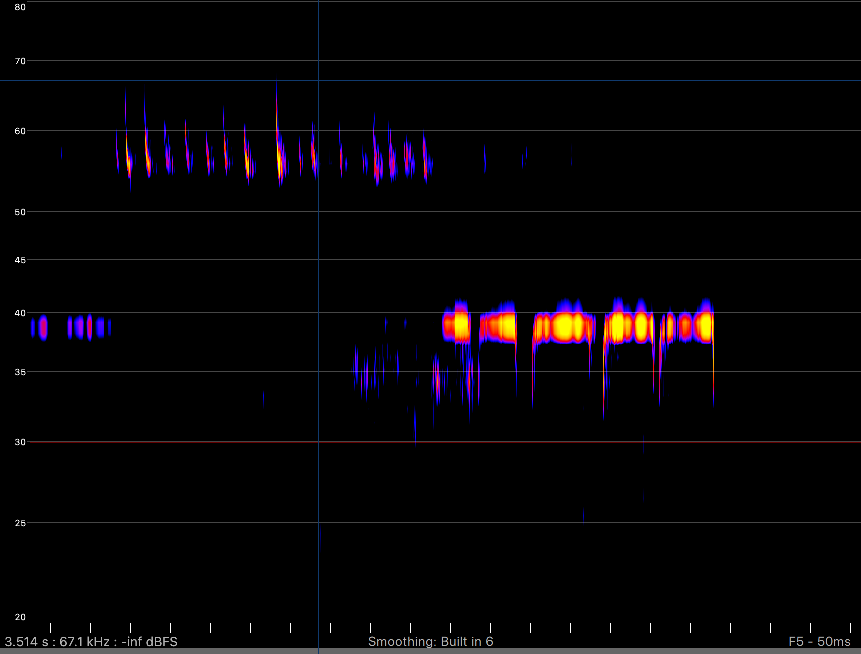
Bat call sonogram. X-axis = time; Y axis = frequency in kHz. The horizontal pulses are from a constant-frequency horseshoe bat currently undergoing taxonomic revision (Rhinolophus intermediate). The higher revers-J pulses are from a frequency-modulated bat (Miniopterus australis) (image credit: Simon Robson)
To aid in this endeavour, he and others are developing acoustic identification keys. An acoustic identification key, or ‘acoustic key’, is a sound file containing a single type of call for a species.
To develop an acoustic key, you ideally need a large dataset of bat calls across the species range where both the species of the microbat and its behaviour at the time of the call is known. By analysing these calls, you can identify the features of a specific behavioural call, such as the searching pulse of a Little Forest Bat (Vespadelus vulturnus).
“Only once you have an understanding of the variability in the calls of a particular species and the context in which they are produced, can you search for and hope to find a unique set of calls for that species,” explains Simon.
When you’re confident of the species-specific features of a particular call, you then select a good quality, representative sound file – that’s the acoustic key for that call. Once an acoustic key is ready, it can help identify species on calls where the species was previously unknown.
As each new acoustic key is established, it contributes to an album of that species’ calls, sort of like a complete collection of a composer’s works. Simon and his colleagues are steadily building a sound library of acoustic keys, which will eventually comprise every call type of every species. In the meantime, he is also working with TERN to develop a database function which will allow users to automatically scan unidentified calls against this growing library.
It sounds like a mountain of work – and it is – especially because recorded calls aren’t always clear or complete. The sound energy is rarely constant throughout a call due to the faintness of certain frequencies, sudden shifts in behaviour, or the bat’s location and movement relative to the recorder. Moreover, some species have complex calls that are just difficult to discern. Recent advances in statistical analysis and computing power are really helping, says Simon.
“People are now using image recognition [of the sonograms], neural networks, machine learning – all sorts of technologies.”
But what really matters is having enough data to work with.
A call for calls
Simon believes the answers to many of the questions we have about microbats can be found in data that have already been collected. Millions of recordings have been collected over the years by different researchers, organisations, and citizen scientists. Unfortunately, only a fraction of them are currently in the TERN database; the rest are scattered across individual hard drives and cloud archives. That’s risky because hard drives degrade or get misplaced, passwords are lost, and data are forgotten when the next project comes along.
Fortunately, TERN has set up the bat acoustics database so anyone can upload data. The TERN site contains simple instructions to help. Simon encourages anyone with bat call recordings to take advantage of this, especially anyone with a big legacy dataset. He’s even happy to help with the process, “Just send it to me, I’ll put it in the database under your name, so you don’t have to do anything.”
“We really need those calls, and they need to be in the one place! The value of being able to analyse all the calls together is immense.”
The data doesn’t even have to be complete, he says, because any data is better than none, and there’s no such thing as too much data. Simon’s advice to potential data contributors is to make it easy on yourself.
“Don’t be concerned if you cannot submit all of your data and are wasting time on the last folder of tricky data. Just send in the stuff that’s easy. It’s still critically important.”
Even unidentified calls help establish the baseline soundscape of an area, which can be monitored for changes. Later, when they are identified with the help of acoustic keys, they’ll contribute to a wealth of knowledge about that species. Such calls might even play a role in the discovery of an entirely new species, as was the case with Rhinolophus R51.
Simon is glad to see more researchers committing, in their projects and proposals, to uploading their data to TERN’s EcoAcoustics database and hopes it becomes standard practice.
“The value of all that information in one place will just be incredible. We can then build the perfect acoustic keys for these bats,” he says. “Then all the really good stuff can happen.”
“The fact that TERN has taken this on is brilliant.”

The microbat database, a TERN-funded initiative, acknowledges a 2023 seed grant from ILTER (ILTER.network) which assisted in extending microbat monitoring into the ILTER-EAP Region.
Feature image at top: Scotorepens greyi (credit: Michael Pennay Flickr CC BY-NC-ND 2.0)