


There is a familiar arc to the history of technology. The first computers filled entire rooms, consuming enormous amounts of power and requiring teams of specialists to operate. Today, the watch on your wrist carries more processing power than those machines ever had. The same story, from vast, expensive and inaccessible to compact, affordable and practical, is now playing out with one of the most powerful tools in environmental science. And for Australia’s farmers and its climate future, the timing could not be better.
A new generation of compact, low-cost eddy covariance flux stations could make it possible to significantly advance our understanding of Australia’s agricultural ecosystems while giving producers practical tools to manage carbon, water and productivity on their own land.
The Eddy covariance (EC) methodology is arguably the most practical tool for monitoring the exchange of energy, carbon, and water between ecosystems and the atmosphere. For this reason, the TERN and its OzFlux research network have maintained numerous EC flux stations around Australia for more than two decades.
These are substantial pieces of infrastructure. Currently, EC flux stations in Australia range from a few metres to 80 metres in height, depending on vegetation height. They are equipped with state-of-the-art instruments that continuously measuring gaseous exchange between the soil, plants, and atmosphere across a range of ecosystems.
“A traditional research-grade eddy covariance system has about 20 individual components,” explains Liam Grace, a researcher in at the Australian Long Term Agroecosystem Research (ALTAR) network supported by TERN. Those components include core instruments — an infrared gas analyser, a sonic anemometer, a multiple component radiometer— which provide core measurements on carbon and water cycles.
The infrared gas analyser is particularly complex and expensive, he says. “It has a motor that rotates optical filters to make really stable, robust measurements with an infrared detector.”
Then there are typically around 17 additional pieces of equipment which are used to record or validate the core measurements. These include multiple dataloggers, phenocameras, modems as well as sensors for air temperature, pressure, humidity, precipitation, and replicated soil temperature, moisture and heat flux . “They contribute quality control and quality assurance to measurements and help models characterise the ecosystem,” he explains.

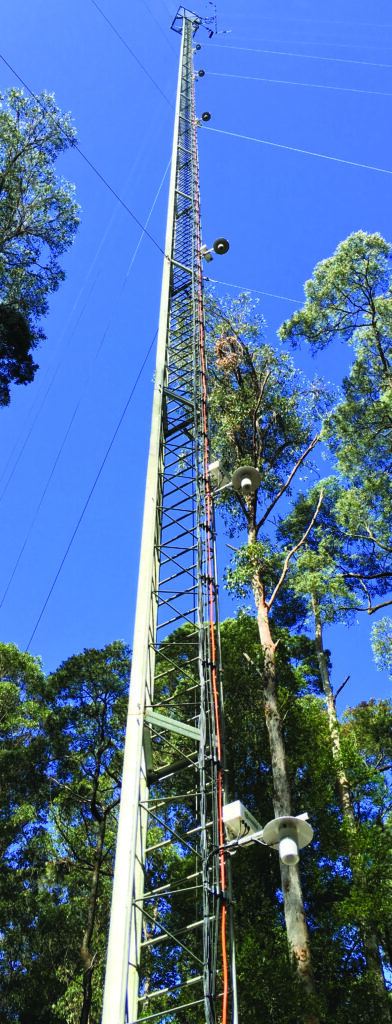
Above: The eddy covariance flux tower at TERN’s Warra Tall Eucalypt SuperSite in Tasmania is 80 m tall. Left: Flux tower components.
This research-grade infrastructure is “the gold standard,” he says, explaining that it’s what you need if you want to collect continuous high-quality data on natural ecosystems. For example, long-term EC flux stations established at TERN’s 18 SuperSites are continuously delivering critical information on carbon and water processes across Australia’s major biomes. Moreover, data from any one tower is integrated into national datasets and global synthesis studies such as FLUXNET and must therefore meet stringent standards.
But there is a significant initial outlay. Research-grade EC tower instrumentation designed to operate typically up to a decade can average around $150,000 and requires specialist expertise to install and maintain. As a result, few have been established on privately operated agricultural land leaving a critical gap in our understanding of ecosystem processes across a significant portion of the Australian continent.
And farmers are missing out, too.
Farmland Flux
Tracking carbon, water, and energy fluxes offers an important means of building a more comprehensive picture of Australia’s ecological health.
Farmers stand to benefit from such flux data, too, says Liam. He sees demand for such data growing across the agricultural sector. Better data on agricultural ecosystem processes, including soil health, helps farmers make important decisions on how to manage their land.
It’s not just the farmers who want the data, but those companies past the farm gate and down the supply chain, who have sustainability and biodiversity targets and reporting obligations. Farmers who wish to sell carbon-neutral agricultural products require carbon-emission and sequestration data to achieve and verify that status. Accurate carbon reporting is also a requirement for accessing the global carbon credit market, which offers financial incentives for adopting carbon-neutral and carbon-negative farming practices. It’s also a matter of productivity. Increasing soil carbon improves its nutrient availability, improving production, and providing more resilience to climate variability. Carbon-rich soil holds water like a sponge, which improves yields and can also mean the difference between a pasture surviving a drought or not.
“I think producers are always interested in the soil carbon side of things, because a carbon efficient farm is a more productive farm,” says Liam. “For example, if pasture production improves and animals gain weight faster, things like that will lower the farm emission intensity of that property.”
In other words, carbon content is a reliable indicator of overall soil health, and healthier soils contribute to greater long-term profitability. But the benefits of EC monitoring extend beyond carbon alone. A clearer picture of the full range of ecosystem processes happening on the land can inform water budgeting, planting decisions, and farm management more broadly.
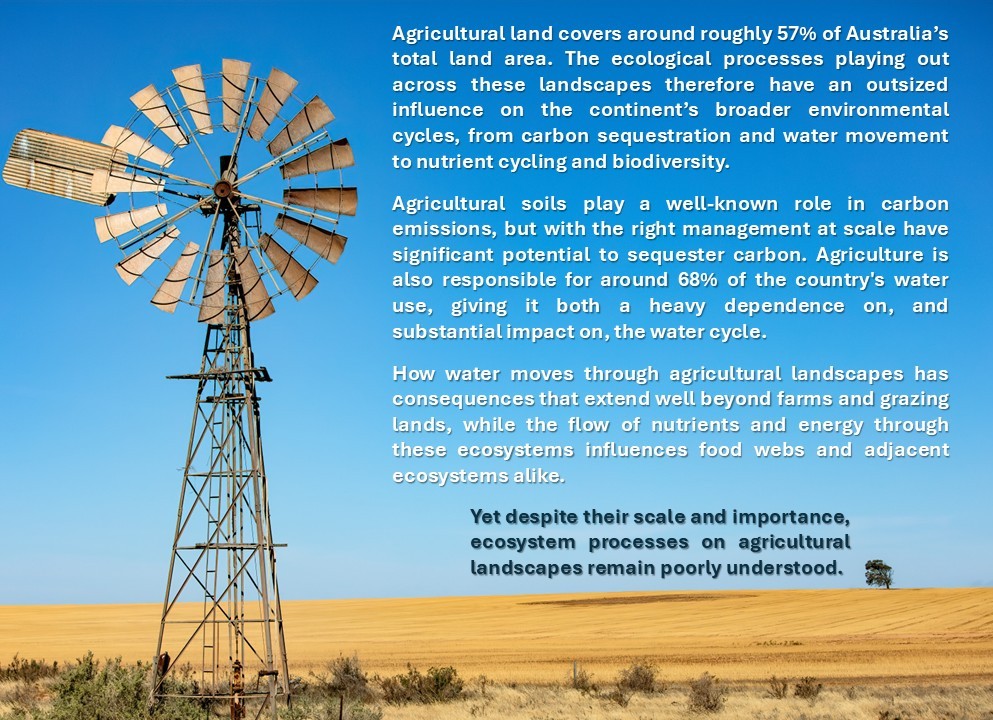
Australian Long Term Agroecosystem Research (ALTAR)
EC data is of clear interest to farmers, and a few have signed on to collaborate with TERN’s Australian Long-Term Agroecosystem Research network (ALTAR), which seeks to provide independent, high-resolution, long-term data on carbon and water dynamics in Australian farming systems. By monitoring real working farms, ALTAR aims to uncover the potential of managed systems to balance productivity with environmental resilience.
With TERN support, Liam and his colleagues at the Sustainable Agroecosystems research group (QUT) have established monitoring sites on those ALTAR farms. The environmental data they are collecting is helping them understand which farming practices lead to excellence in productivity and ecosystem sustainability outcomes
“The EC flux measurements from conventional systems are an important part of this work,” says Liam. “The network has been lucky to already partner with great, well-respected producers across the country — with most monitoring sites established in the productive pastures of Queensland’s Brigalow Belt, but it’s continuing to expand.”
However, most agricultural producers are understandably reluctant to establish a complex and expensive flux station on their properties. The challenge is compounded by scale: many properties cover vast areas encompassing very different landscapes, such as pastureland, crops, and grazing rangelands. Capturing that variation meaningfully would require multiple EC stations, each monitoring a different part of the property.
For many producers, that’s a non-starter. The resulting data gap means missed opportunities to increase carbon uptake, reduce water use, build soil carbon, and improve both soil health and economic productivity.
Liam believes there is a way forward that could benefit ecosystem researchers and farmers alike.
Small wonders
Just as the room-sized computers of the 1950s gave way to the devices we carry in our pockets and wear on our wrists, the technology underpinning environmental sensing is following the same arc. What once required a structure as tall as an eight-storey building and the complexity of a small laboratory can now be held in one hand and sent in a box by post.
“The sensing infrastructure is changing,” says Liam. EC flux stations are now available that are simpler, easier to maintain and available at lower cost compared to conventional platforms. They’re small, weigh around 2 kilograms and only require 1.5 watts to operate.
How is this possible? First, these compact EC flux stations carry a much leaner suite of instruments. Instead of 20 sensors, they combine around 6 sensors into one combined instrument.
“Those core instruments allow us to measure monitor carbon and water fluxes, which are the main measurements we’re interested in,” says Liam.
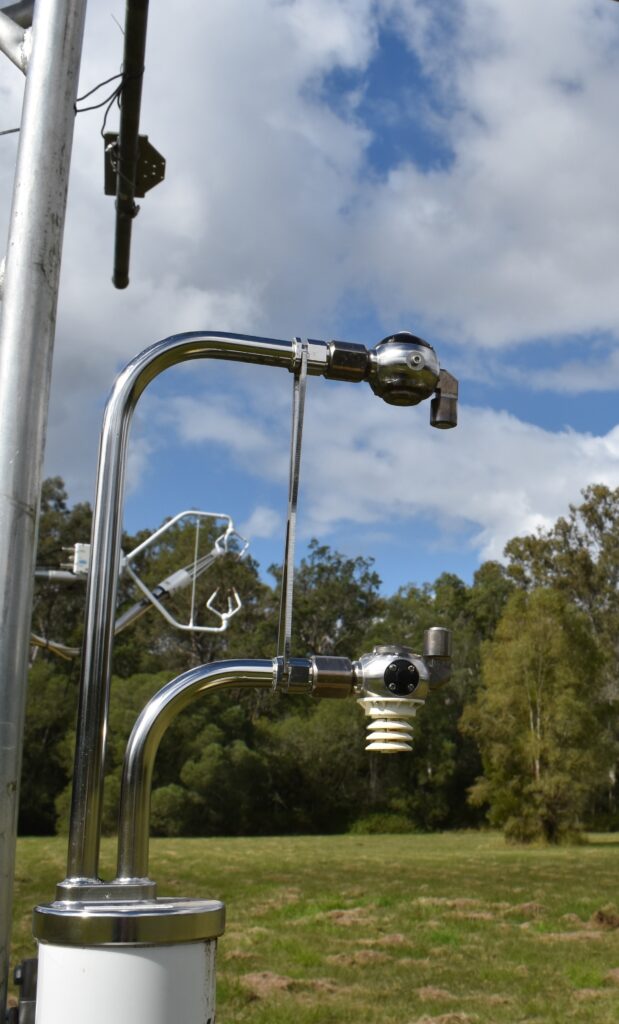
The instrument also collects supporting measurements on meteorological conditions – air pressure and temperature, and relative humidity, and photosynthetically active radiation (PAR) . There is still a fast response gas analyser, which is necessary for measuring carbon and water fluxes.
The miniaturisation of electronic components and improvements in fabrication techniques have been crucial.
“A lot of the circuit boards in the original gas analysers were larger, and through-hole soldered by hand,” says Liam. “Now, 30 years later machines can manufacture these in much more compact forms.”
The same relentless shrinking of components that put a supercomputer on your wrist has quietly transformed what’s possible in a field sensor.
Left: the compact EC flux station in use at TERN’s peri-urban SuperSite situated at the SERF near Brisbane. The compact EC flux station has been placed next to conventional research-grade EC flux station (partially viewed in background) (image credit: Liam Grace)
The trade-offs
Some notable compromises were made in the pursuit of diminished size and cost. For example, improvements in optics have removed the need to power a chopping motor in the gas analyser, but consequently, a trade-off may be that the measurements are ‘noisier’ or not as resilient to contamination compared to their well-proven predecessors.
Furthermore, the smaller payload of instruments this means there are no additional sensors to support the primary measurements, so there’s more uncertainty in the core carbon and water flux data.
But that’s acceptable, says Liam. “We don’t really need to make research-grade measurements at every site.”
“The main focus of ALTAR is to help the agricultural industry answer many questions around productivity, on nature-based solutions and on things like water budgeting, irrigation questions.”
“The core measurements from these new EC systems still tell us about the carbon and water dynamics of agricultural ecosystems, which can be used for looking at all those questions.”
Because they’re fit for purpose, Liam’s goal is to get these compact EC flux stations onto more farms. And the design factor matters as much as the function. When something looks like it belongs in a research institution, farmers reasonably assume it isn’t for them. The new stations change that dynamic entirely.

“I think it makes it a lot easier when they don’t see this big tower with 20 different instruments on it. Instead, it’s like, ‘look, here is a single sensor, something that’s just 2 kilos and something they could maybe even set up themselves.’”
The low maintenance is a key selling point. On a conventional EC flux station, a faulty sensor means sending out someone with specialist expertise and all the right tools for every possible issue, travelling to remote sites, gaining access, and either working on-site or making multiple trips. That’s a significant investment of time and effort for both the research team and the farmer.
With the compact stations, the process is far simpler. “Instead of someone going out to replace a sensor, the farmers can package it up and post it back,” says Liam. “We send a new one and they go and fit it on.”
Strength in numbers
With the potential to get more farmers on board and keep costs low, it becomes feasible to deploy multiple EC flux stations across the landscape. Scaling up will be critical, says Liam. Measurements drawn from a wider area would be more representative of real agricultural systems, feeding into models with greater spatial coverage and statistical robustness.
“An ideal scenario would be many low-cost towers with simple instrumentation spread throughout the landscape supporting a small number of conventional towers,” says Liam. This isn’t just about broader coverage, it also addresses the problem of data uncertainty for any individual tower.
“Data from a massive network can be used to fill in gaps and improve statistical robustness through increased replication,” he explains.
“We don’t need them in every paddock. What we want is enough to start to lower the uncertainty from modelled estimates across different agricultural systems, whether it’s cropping, pastures, or different management styles and techniques.”
The logic is the same as in any networked technology: the value isn’t just in each individual node, but in what becomes possible when enough of them are connected.
Benefits
The data from compact EC flux stations could give farmers a detailed, continuous picture of how their land is performing across seasons and from year to year. They could also benchmark that performance against neighbours or regional averages.
“At ALTAR one of the main things we’re trying to tease out with producers is different grazing and pasture improvement techniques. With these EC stations we can track how different techniques or pasture renovation practices affect carbon storage in the soil and plants and water use efficiency.”
Producers can start to make finely tuned management decisions based on real data from their own land. “They can say, ‘oh, look, I’ve had a lot more growth in that paddock two to three weeks ago, maybe I can move my herd in there a bit earlier.”
“They might also say: we had 100 millimetres of rain, there’s been all this growth, but then there’s been 80 millimetres of evaporation and transpiration, so I’m probably getting a bit low in water there. My growth might actually start to level off soon.”
If farmers need to cultivate a field, the EC flux station will pick up how much carbon has been lost from the soil, and how the soil’s water retention may have changed. The data can show whether a change in management may qualify a producer for carbon credits or other supply chain incentives, giving them a financial incentive to implement further change across their property.
By hosting an EC flux station, agricultural producers are contributing to large scale data collection and research on carbon and water cycles. As the measurements are uploaded to the research cloud, Liam and his colleagues are able to collate and analyse the data.
And this isn’t a case of scientists telling farmers what to do and what to measure. It’s a collaboration. “The agricultural producers are often involved in the co-design of the project,” says Liam.
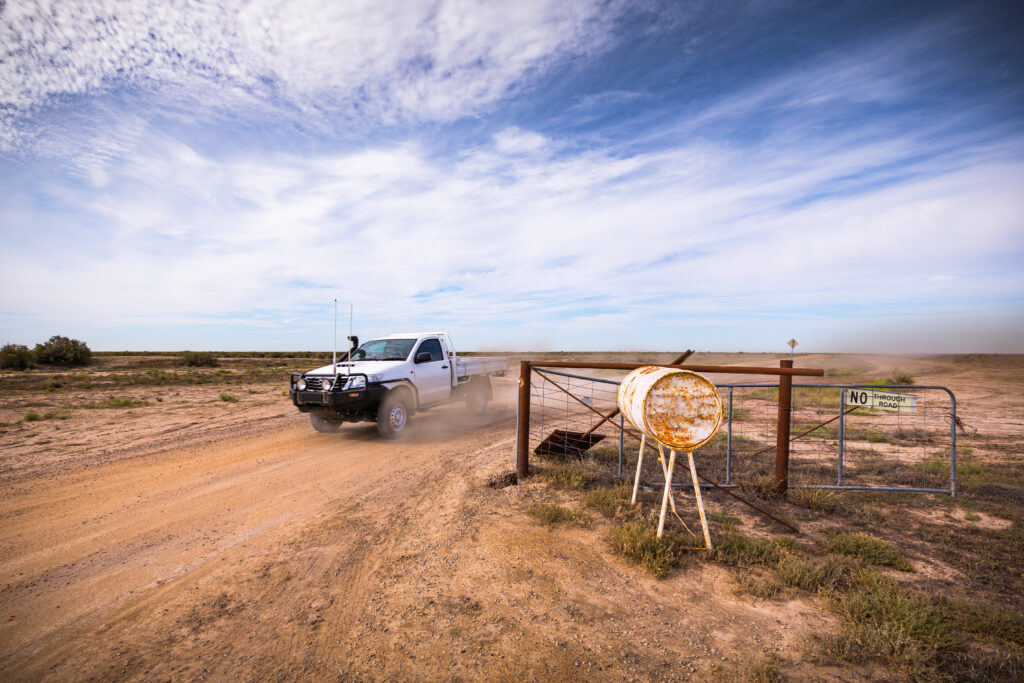

In the field
For the researchers, the most time intensive part of the process now is gathering detailed information about land management practices from each farm, so they can match up cause and effect.
“A big part of that is driving out to different properties, then sitting around and having long discussions,” he says. “You get a caffeine buzz, because at the end of the day, you’ve been asked to come into the house and have a cup of tea about 8 times, but that’s where you can begin to understand the full picture. ”
In return for their participation and hospitality, the farmers not only get the EC flux station installed but also get the benefit of accompanying data collection by the researchers such as ongoing soil sampling as well as plant biodiversity surveys.
Getting ready
So far, a small number of agricultural properties have expressed interest in participating and Liam and his colleagues are in the process of negotiating those agreements. But to roll this program out at scale, the researchers want to accumulate early data they can then showcase to landowners and other agricultural producers to bring more on board. They also need to prove that these compact EC flux stations, developed overseas, can handle the Australian environment.
“Australia is hard to operate in because it’s hot and harsh, and the distances are just huge. You’ve also got humid conditions, birds, insects — you want to check all that because if you’re going to put a sensor out there you want to know it performs reliably before you commit to a wide roll-out.”
With this in mind Liam and his colleagues have established a “validation site” at the Samford Ecological Research Facility (SERF) north of Brisbane, home of TERN’s peri-urban SuperSite. They set up a compact EC flux station next to TERN’s research grade flux tower, which has been recently refurbished and upgraded with support from the Queensland Government Research Infrastructure Co-investment Fund (RICF). Over the past year they have been testing the new instruments and techniques to see how it performs in comparison to the conventional research-grade instruments.
Meanwhile, Liam and the TERN data team are developing a data dashboard that farmers can use to monitor insights from the compact EC flux measurements as well measurements from conventional flux stations in the ALTAR network. They are also preparing and uploading datasets from working farms onto a central data repository that researchers can access.
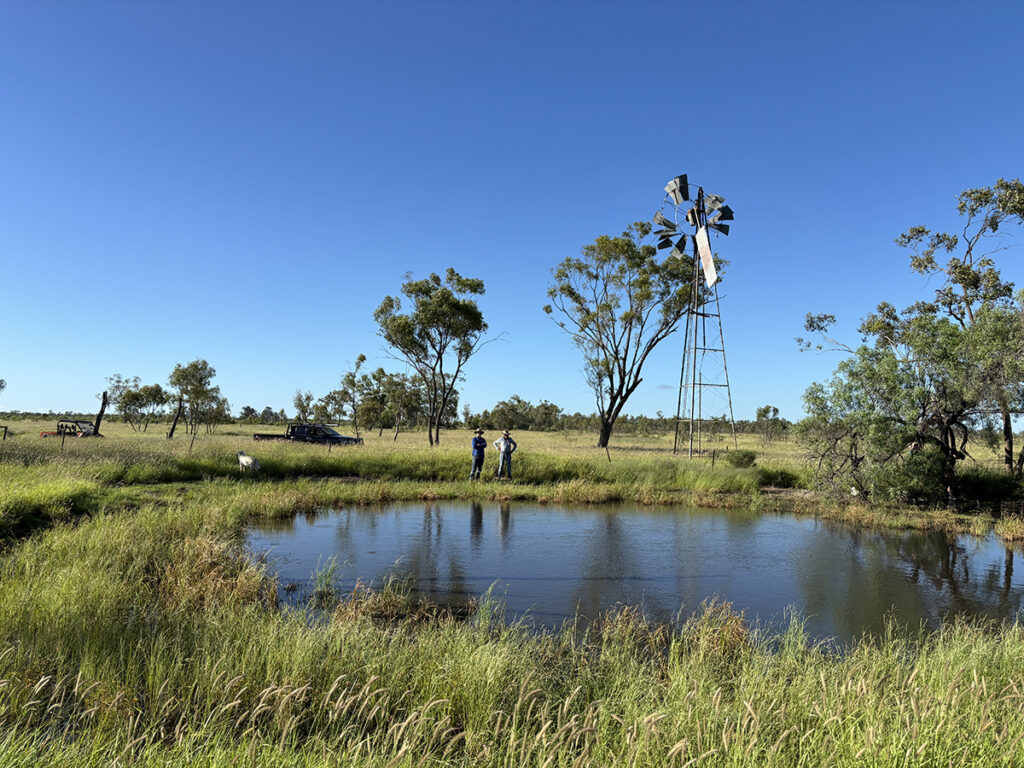
The potential reach of this TERN work extends well beyond individual farms. A national network of low-cost EC stations, deployed across diverse agricultural landscapes and managed in partnership with the producers who work them, could transform what is currently a patchwork of estimates into a robust, ground-truthed picture of how Australian agriculture interacts with the carbon cycle, the water cycle and the living systems that underpin both.
As Australia works toward its net zero commitments and biodiversity targets, that picture may prove as valuable to policymakers and land managers as it is to the farmers hosting the stations themselves. Technology has a way of becoming small enough to change everything. For Australian agriculture, that moment may finally have arrived.

Feature image: thanks to the miniaturisation of electronic components small, hand-held devices like smart phones now have more computing power than the first supercomputers that took up entire rooms. These advancements are also helping developers decrease the size of the instruments in EC flux stations (image: Adobe iStock).