
TERN’s Education and Training Manager, Dr Eleanor Velasquez, recently attended the Australian Science Teachers Association’s (ASTA) national conference where she joined science teachers from across the country to connect, exchange ideas, and hear the latest approaches to educating and inspiring students. Here, Eleanor shares her experience and tells us about the TERN-supported workshop she presented, offering teachers and students an opportunity to meaningfully engage in real-world ecosystem research.
By Eleanor Velasquez
They say the best educators inspire you to think differently and more creatively, they connect you to contexts beyond what you already know and to ideas and possibilities beyond your current realm of experience. They bring these elements into your imagination and classroom and make them real – because they are.
That’s how I have walked away from ConASTA 73: the 73rd conference of the Australian Science Teachers Association (ASTA), which was held in Brisbane earlier this month. This year’s theme, Science in an Era of Rapid Change: Supporting Sustainability, sought to explore how science education can respond thoughtfully and effectively to accelerating environmental, technological, and social change. I was privileged to attend many stimulating workshops and keynotes on why science education matters and how we can inspire the next generation of scientists and STEM professionals.

Members of the Australian Science Teachers Association (ASTA) gather for ConASTA 73, which also included a talk from Australian astronaut Katherine Bennell-Pegg (on stage) (image credit: Eleanor Velasquez)
Several key messages for success in this arena stood out:
- Start younger while kids are still curious;
- You can’t be what you can’t see, so make science careers obvious and relatable;
- Connect students to local contexts instead of distant places they may never visit due to economic, social or contextual barriers;
- Incorporate the 6 Cs for education in the 21st century: creativity, critical thinking, collaboration, communication, character and citizenship;
- Flip your thinking: instead of trying to the connect maths or science curriculum to Traditional Custodian’s cultures, begin with culture and connect maths or science to this deep and relational way of thinking and knowing.
For my part, I was excited to deliver my first professional development workshop for science teachers, which aimed to bridge the Australian science curriculum to TERN’s extensive ecological data resources. This included an introduction to TERN’s rich data repository, field methodologies, as well as other valuable educational assets such as Australia’s Environment Report and the Threatened Species Index.
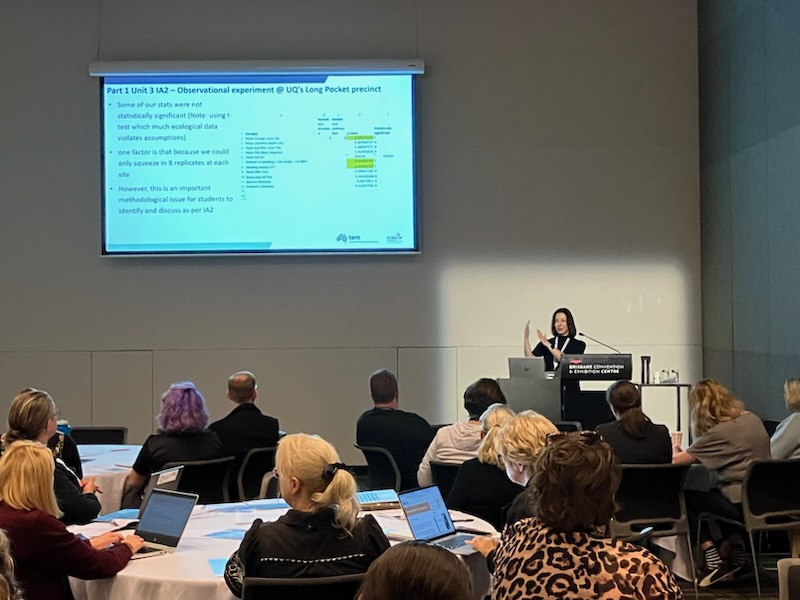

Right: Eleanor Velasquez presents a professional development workshop to science teachers at ConASTA 73; Right: Eleanor (left) and Elisa Giroloa (right), who is a member of the TERN data team (images provided by Eleanor Velasquez)
The workshop also focussed on how teachers and students across Australia can gain experience contributing data to TERN’s data repository. For example, they can collect ecological data following TERN’s Senior Science field methodology, which qualifies for the senior science Internal Assessment 2 (IA2) in Queensland. Moreover, data collected using this methodology can now be added to TERN’s newly established long-term school dataset repository Flora and Soil Surveys for Senior Secondary Biology and Geography, which was championed by my TERN colleague Dr Elisa Girola and the TERN data team. By providing this data, students and teachers are able to contribute to national long-term studies of Australia’s ecosystems.
The teacher toolkit for this package includes detailed teaching lesson plans, a TERN Australia derived field methodology to follow, data templates, worksheets and calculations, which are all designed to make teachers’ lives easier. Our hope is that via these resources teachers can make visible the career paths and professions available to students if they choose STEM and embed their students’ thinking in localised contexts that are relatable and meaningful to their classroom. In doing so, we hope teachers and students will feel connected to research activities and professions that may have once seemed distant from their high school studies but are now present within their everyday classrooms.
These TERN educational resources were designed as an engaging way to raise awareness of ecological principles and career pathways. They align strongly with TERN’s vision of advancing ecosystem science and sustainable environmental management and are a great example of our commitment to creating educational resources that make science accessible and meaningful to broad audiences.
I hope you feel as inspired as I do for the next generation of emerging scientists and STEM professionals who are being taught by dedicated science teachers in classrooms across Australia right now.
Further information
We are currently developing a dedicated website where these curriculum-aligned Senior Secondary teaching resources can be readily accessed, so watch this space.
The link to where your school’s dataset will live should you wish to contribute to this project https://portal.tern.org.au/metadata/TERN/e35b48f3-2cf4-4d2e-9744-3c6bb90aa7ce
Please email TERN’s Education and Training Manager (Eleanor) for any questions on this project or to contribute your class dataset to our repository: e.velasquez@uq.edu.au
And reach out to us at TERN Australia with any questions you may have or ideas for future teaching resources that would enable you to connect your students with us via tern@uq.edu.au or e.velasquez@uq.edu.au.