How TERN’s Education Strategy comes alive at the Litchfield Savanna SuperSite
Published
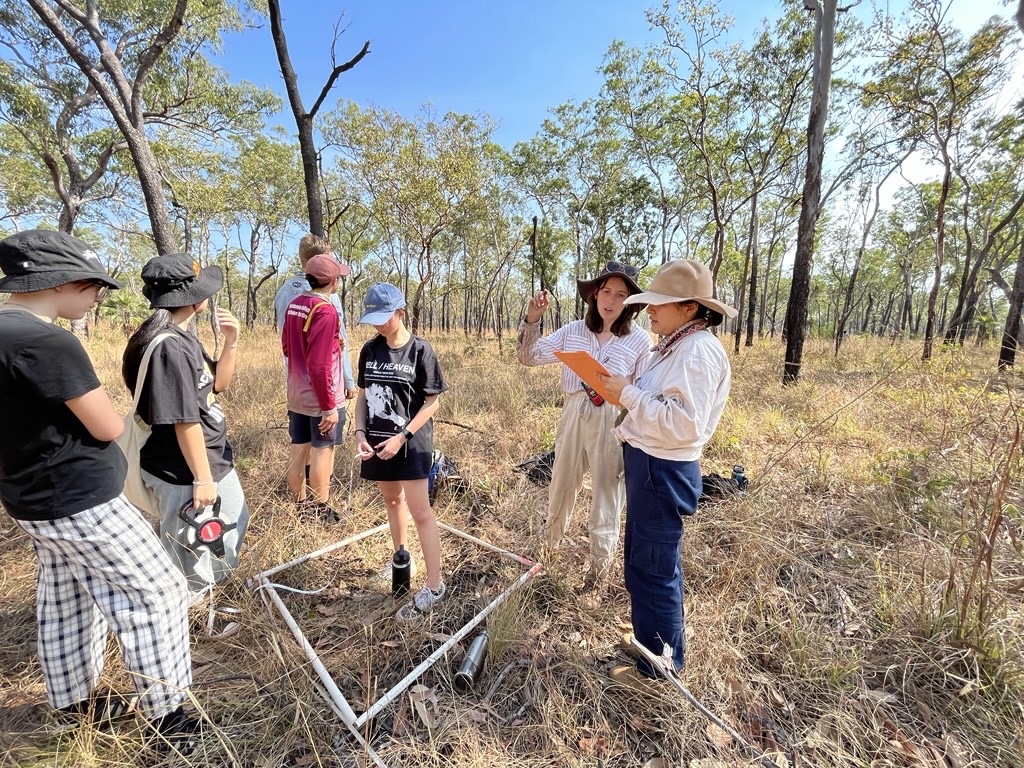
Students from Charles Darwin University’s Bachelor of Environment Science and Master of Environmental Management (MEM) courses recently transformed Litchfield National Park in the Northern Territory, Australia, into a living classroom, using TERN’s national ecosystem monitoring infrastructure to investigate how tropical savannas function, respond to fire and change through time. The field intensive demonstrated to students how TERN’s infrastructure and Education Strategy provide authentic research experiences and multi‑modal environmental observations in one of Australia’s most iconic landscapes.
By Donna Lewis
Learning with national‑scale ecosystem data
Guided by Professor Lindsay Hutley (Charles Darwin University, TERN Ecosystem Processes), Dr Donna Lewis (Adelaide University, TERN Ecosystem Surveillance) and Associate Professor Nicholas Friedman (James Cook University, Ecosystem Processes Lead), students engaged directly with TERN’s long‑term monitoring assets. Rather than simply touring the TERN Litchfield Savanna Supersite’s flux tower, the cohort explored how continuous measurements of carbon, water and energy exchanges reveal the “breathing” of savanna ecosystems and their responses to fire, climate variability and seasonal transitions.
Students have been taking measurements of woodland biomass and plant cover every year at this TERN site since 2015, all within the footprint of the TERN flux tower. This hands‑on engagement has enabled students to understand the power of long-term monitoring of ecosystem function and exemplifies TERN’s commitment to data‑driven learning and building national capability in environmental interpretation.
Top three images: Since 2015 CDU student cohorts have gathered data and learned about long term ecosystem monitoring at TERN’s Litchfield site (credit: TERN); Centre image: This year’s cohort of CDU students attend presentations at the flux site (image credit: Donna Lewis). Bottom: Litchfield site map (left) and flux tower (right) (image credits: TERN).
Experiencing multi‑modal monitoring in an iconic savanna landscape
At the flux tower, Professor Hutley introduced the ecological significance of Litchfield’s fire‑prone savannas, showing how long‑term measurements help researchers quantify post‑fire recovery and vegetation productivity. Associate Professor Friedman demonstrated TERN’s passive acoustic monitoring technologies, highlighting how continuous sound recordings complement traditional biodiversity surveys and reveal patterns invisible to short‑term fieldwork.
Dr Lewis guided students through the integration of field observations, curated plant and soil samples, drone‑based remote sensing and TERN’s accessible datasets. Together, these approaches illustrated how TERN’s multi‑modal monitoring framework provides a comprehensive picture of ecosystem condition, a core principle of the TERN Education Strategy.
Litchfield site panorama (credit: TERN)
Authentic research experiences for emerging environmental professionals
Throughout the intensive, students applied TERN protocols, designed small investigations and interpreted real environmental datasets. By linking on‑ground observations with national‑scale monitoring, the cohort experienced the full pathway from data collection to ecological insight. This authentic research practice is central to TERN’s goal of equipping Australia’s future environmental workforce with the skills needed to work confidently with long‑term, open data.
Partnerships that build national capability
The collaboration between TERN, Charles Darwin University and NT Parks demonstrates how universities can embed national research infrastructure into curriculum design. By providing students with direct access to TERN’s monitoring systems, datasets and expertise, the partnership supports the development of ecosystem literacy and strengthens Australia’s capacity for environmental research and management.
Set against the dramatic backdrop of Florence Falls, the Tabletop Plateau and Litchfield’s tropical savannas, the field intensive showcased how national research infrastructure can inspire and empower the next generation of environmental scientists.
Florence Falls in Litchfield National Park (image credit: Donna Lewis)
TERN Education Impact
The annual field intensive led by Professor Lindsay Hutley at the TERN Litchfield Savanna SuperSite demonstrates TERN’s Education Strategy in action, delivering the following core outcomes for Masters students:
✔ Data‑driven learning. Students work directly with flux, acoustic and drone datasets to interpret savanna ecosystem processes and environmental change.
✔ Integrated monitoring. Hands‑on engagement with TERN’s multi‑modal infrastructure, including sensors, curated samples, remote sensing and open‑access data.
✔ Authentic research skills. Students apply TERN protocols, design small investigations and analyse national‑scale environmental datasets.
✔ Place‑based learning in an iconic landscape. Litchfield’s fire‑prone tropical savanna provides a powerful setting for understanding ecosystem dynamics and long‑term monitoring.
✔ Workforce capability uplift. The TERN-CDU partnership strengthens Australia’s future ecosystem workforce by building data‑literate, monitoring‑ready environmental professionals.
Litchfield watercourse (credit: TERN)
Feature image: group photo of the CDU student cohort and mentors at the TERN Litchfield flux tower (credit: Donna Lewis)